AEO: Answer Engine Optimisation — Why It’s Needed Now (and Why Older Websites Need a Rebuild)
AEO: Answer Engine Optimisation
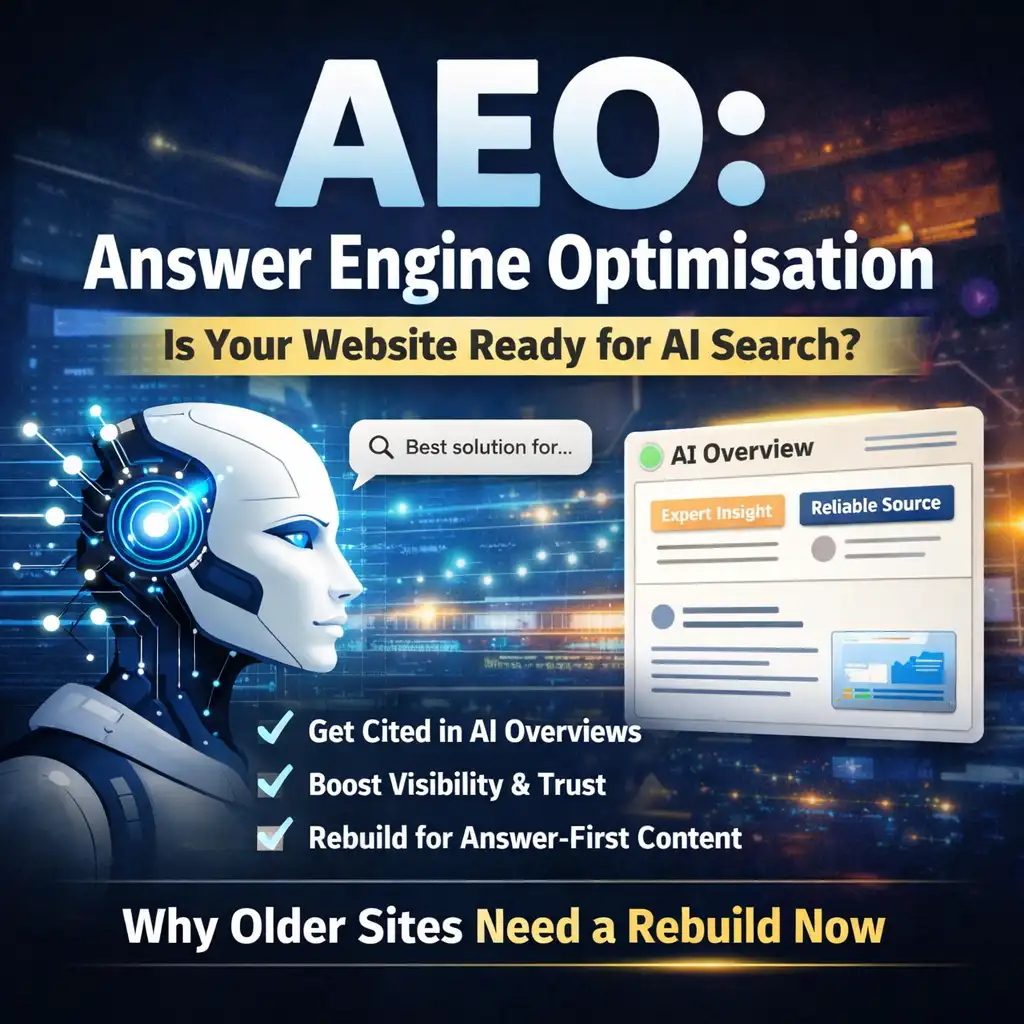
Search is no longer just “10 blue links”. More people now get instant answers inside AI-powered summaries and chat-style tools — and they often don’t click unless a source looks genuinely helpful and trustworthy. Answer Engine Optimisation (AEO) is how you structure your website so those engines can understand it, trust it, and confidently cite it. For many older websites, AEO isn’t a quick tweak — it’s a website rebuild.
What is AEO (Answer Engine Optimisation)?
AEO is the practice of optimising your content so “answer engines” can extract clear, accurate responses and attribute them to your site. It includes AI-powered search summaries (like Google’s AI Overviews), voice assistants, and chat-style discovery tools. Traditional SEO still matters — but AEO shifts the goal from “rank a page” to “be the source that gets quoted”.
- SEO targets rankings and clicks.
- AEO targets citations, summaries, and direct answers — which then drive higher-intent visits.
- AEO content is structured for fast comprehension: questions, concise answers, supporting detail, and proof.
Why AEO is needed now (not later)
AI answers are expanding, and user behaviour is changing with them. When AI summaries appear, click behaviour often drops — meaning fewer “casual clicks” and more visibility concentrated in what’s cited. In other words: if you’re not included in the answer, you’re often invisible at the moment of decision.
- AI summaries reduce clicks: fewer users click traditional results when an AI summary is present.
- Questions are longer and more specific: people ask conversational, multi-part queries and expect instant, structured responses.
- Citation becomes the new top position: the “winner” isn’t always rank #1 — it’s the source the answer engine chooses.
How answer engines choose what to cite
Answer engines don’t read websites like humans. They look for content that’s easy to extract, consistent, and supported by evidence. That means: clear headings, direct answers, strong internal structure, and trust signals that validate your claims.
- Clear, direct answers near the top of relevant sections.
- Entity clarity (who you are, what you do, where you serve) across the whole site.
- Structured data that matches visible content.
- Internal linking that helps engines find your key pages quickly.
- Strong page experience so users don’t bounce when they do click.
If you want to go deeper into AI visibility beyond classic SEO, explore GEO (Generative Engine Optimisation).
Why older websites struggle with AEO
Many older websites were built for a different era: desktop-first layouts, thin pages, clunky navigation, slow load times, and copy that talks around a topic instead of answering questions. AEO exposes those weaknesses quickly — because answer engines prefer content that’s structured, scannable, and technically clean.
- Poor information architecture: services buried, unclear hierarchy, thin pages.
- Slow performance: bloated scripts, unoptimised images, weak mobile experience.
- Unclear topical focus: one page trying to rank for everything (and answering nothing properly).
- Weak trust signals: missing proof, case studies, results, or credible references.
- Technical friction: messy templates, inconsistent headings, duplicate metadata, crawl/index issues.
AEO isn’t “just add FAQ schema” anymore
FAQs still help users — and they can still help answer engines summarise your page — but relying on FAQ rich results as a visibility hack is outdated. Google’s own documentation notes that FAQ rich results are now limited to authoritative government and health sites.
- Use FAQs to remove doubt, handle objections, and make answers easy to extract.
- Prioritise schema that reflects what’s actually on the page (and keep it consistent with visible text).
- Focus on clarity + proof — not markup tricks.
2026 reality check: what the data shows
Below is a snapshot of widely-cited, recently published findings (2025 → early 2026 context) showing how AI answers are changing search visibility. Use this as the “why now” business case for AEO.
| What’s changing | Observed impact (latest published) | What it means for AEO |
|---|---|---|
| AI Overviews global availability | Expanded to 200+ countries/territories and 40+ languages (May 2025). | AEO is no longer optional — AI answers are mainstream, not a niche feature. |
| Clicks when an AI summary appears | Pew found users clicked a traditional result in 8% of visits with an AI summary vs 15% without one; clicks on summary links were about 1%. | Winning means being cited/selected — not only “ranking”. Build answer-first sections and proof blocks. |
| Organic CTR drop on AI Overview queries | Seer Interactive reported organic CTR for AI Overview queries dropping to about 0.61% (with higher CTR when no AI Overview appears). | Structure pages so you’re the source inside the answer — then capture the higher-intent click. |
| Benefit of being cited | Seer reported brands cited in AI Overviews earned more clicks than those not cited (organic and paid uplift reported). | AEO is a “selection game”: credibility + structure + entity clarity increase citation likelihood. |
| “No special optimisations” claim (Google) | Google states SEO best practices remain relevant; no special markup/files are required beyond strong fundamentals. | AEO success still starts with solid foundations: crawlability, internal linking, page experience, clear text content. |
| FAQ rich results visibility | Google documentation: FAQ rich results are now generally limited to authoritative government/health sites. | Use FAQs for comprehension and extraction — not because you expect rich-result boosts. |
Tip: Pair AEO with conversion work so the traffic you do earn converts efficiently. If you want that layer, explore CRO (Conversion Rate Optimisation).
What an “AEO-ready website rebuild” looks like
A rebuild for AEO focuses on foundations first: structure, speed, clarity, and trust. You’re not just changing the paintwork — you’re rebuilding the frame so modern search systems can understand your business instantly and cite it confidently.
- New page structure: one core service per page, supported by subtopics and FAQs.
- Question-led headings: H2/H3 sections that mirror how people search (and how AI summarises).
- Answer-first content: concise answers up top, then depth, examples, and proof.
- Schema that matches the page: accurate structured data aligned to visible copy.
- Speed + UX rebuild: mobile-first templates, optimised assets, improved usability.
- Trust upgrades: case studies, testimonials, clear authorship, and transparent policies.
- Internal link strategy: connect service pages, supporting articles, and conversion paths.
This is where strong build quality matters: website development that’s clean, fast, and easy for both humans and machines to interpret.
AEO content patterns that get cited
If you want to show up inside AI answers, your content needs to be easy to quote. That means writing like a helpful expert — not like a brochure — and supporting claims with proof. This is where great copywriting and content creation pays off.
- Definition + context: “AEO is… Here’s when you need it… Here’s what to do next.”
- Step-by-step processes: clear sequences, checklists, and decision trees.
- Comparisons: “Option A vs Option B” with practical recommendations.
- Local clarity: service + location + proof (projects, reviews, coverage areas).
- Proof blocks: outcomes, before/after metrics, examples, and screenshots.
Quick self-check: does your site need rebuilding for AEO?
If you answer “yes” to several of these, a rebuild is usually the fastest path to AEO visibility (and better conversions):
- My service pages are thin, outdated, or unclear.
- The site is slow on mobile and fails speed/performance checks.
- Navigation is messy and key services are hard to find in 1–2 clicks.
- I don’t have strong case studies, reviews, or proof on the page.
- Headings aren’t structured (multiple H1s, skipped levels, random styling).
- I’m relying on old SEO tricks instead of answering real customer questions.
- I have no structured data strategy beyond “a plugin installed it”.
FAQs: Answer Engine Optimisation (AEO)
No — AEO builds on SEO. SEO still drives indexing and visibility, while AEO improves how your content is extracted, summarised, and cited in AI-driven answers. The best strategy is SEO foundations + AEO structure.
No. Schema helps machines understand your pages, but it doesn’t guarantee inclusion. You still need helpful content, strong technical SEO, and real trust signals so engines feel confident citing you.
Yes — because users still ask questions, and answer engines still need clean Q&A content to summarise. Don’t add FAQs as “SEO fluff”. Add them to remove doubt, handle objections, and make your pages easier to quote.
Sometimes — if your site is already fast, mobile-friendly, well-structured, and technically clean. But if your templates, navigation, performance, or content structure are holding you back, AEO changes often stall until the foundations are rebuilt.
Start with the pages closest to revenue: core service pages, location/service-area pages (if you’re local), and “money” landing pages. Then support them with blog explainers that answer the common pre-sale questions your customers ask.
Writing vague marketing copy that avoids specifics. Answer engines reward clarity: what you do, who it’s for, how it works, what it costs (even ranges), what results look like, and what to do next — backed by proof.
Rebuild Your Website for AEO (and Stop Losing Visibility)
If your website was built for “old SEO”, it may not be structured for AI answers. Forwardify rebuilds websites with speed, structure, schema, and conversion in mind — so your business can be cited, trusted, and chosen in AI-first search.

Thomas Carpenter
FounderWorking closely with clients to create visually compelling, strategic solutions built for long-term growth is what we do.
Contact us Whatsapp