SEO vs AI Search: What’s the Difference?
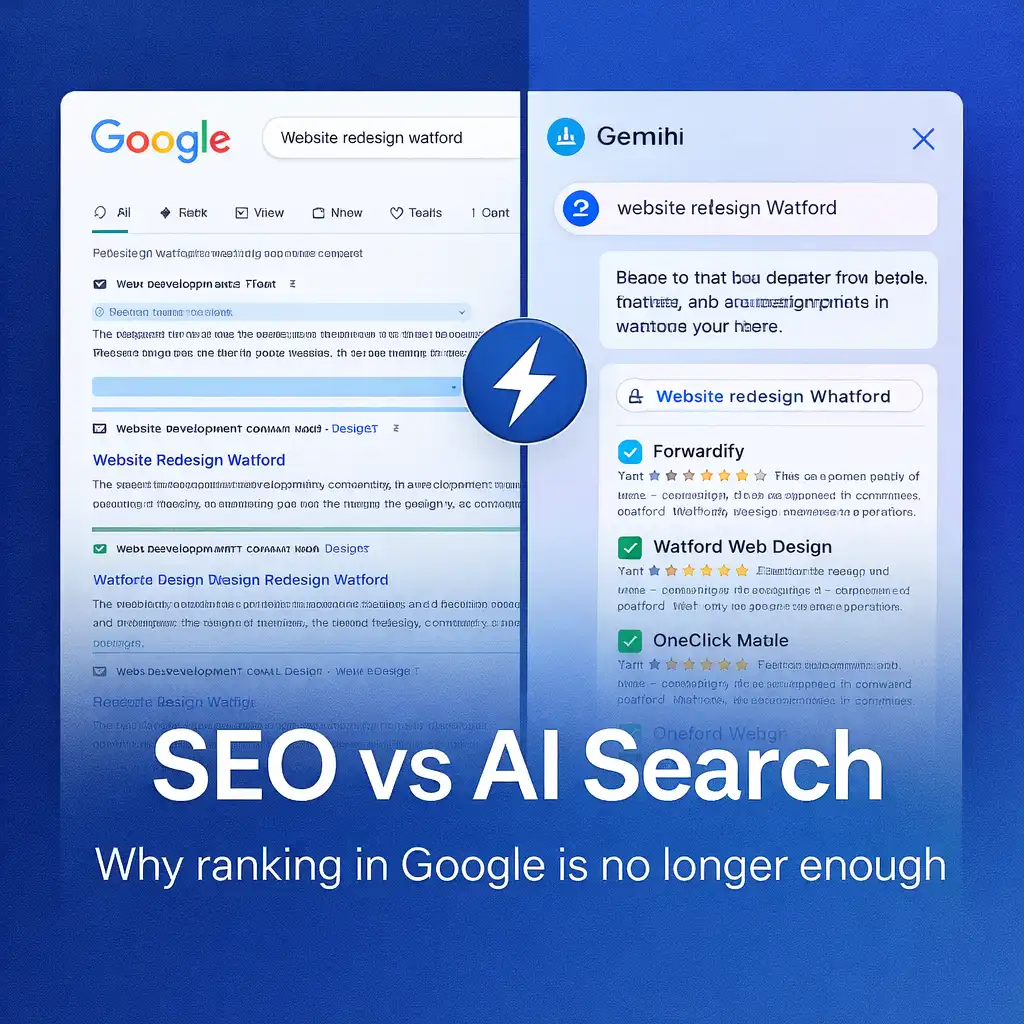
SEO has powered online visibility for years — but search is changing fast. Millions of people now use AI chatbots (like ChatGPT, Gemini and Copilot) to find answers and recommendations without scrolling through a list of links. If your website is not optimised for AI search, you risk becoming invisible to a growing share of your potential customers.
What Is Traditional SEO?
SEO (Search Engine Optimisation) is the process of improving your website so it ranks higher in search engines such as Google. Traditional SEO is focused on making pages easier to crawl, index and rank — so that when users search for services (e.g., “website redesign Watford”), your site appears near the top of the results.
- Keyword research and on-page optimisation (headings, content, titles)
- Technical SEO improvements (site speed, mobile usability, crawlability)
- Content quality and search intent alignment
- Authority building through relevant backlinks
- User experience signals (engagement, time on site, low bounce rate)
What Is AI Search?
AI search refers to how Large Language Models (LLMs) and AI search engines surface information to users — often as a direct answer rather than a list of websites. Instead of “ten blue links”, AI tools typically provide a summarised response, suggested options, and in some cases citations or references.
- Users ask questions in natural language (conversational queries)
- AI generates a single, synthesised answer (often “zero-click”)
- Some tools cite or recommend sources they consider trustworthy and clear
- Discovery can happen without a traditional Google search at all
SEO vs AI Search: Key Differences
SEO and AI search overlap — but they behave very differently. SEO typically rewards keyword relevance, technical quality and authority. AI search rewards clarity, structure, topical depth and “understandability”. If an AI can’t interpret what you do, who you serve, and why you’re credible, you’re far less likely to be recommended.
| Area | Traditional SEO | AI Search (LLMs / Chatbots) |
|---|---|---|
| Result format | Ranked list of links (SERPs) | Direct answers, summaries, recommendations |
| User behaviour | Click and browse multiple sites | Ask and trust the response (often no click) |
| Visibility driver | Keywords, backlinks, technical SEO | Context, clarity, authority and structured information |
| Optimisation focus | Search phrases + page ranking | Semantic meaning + content understanding |
| Impact of structure | Important, but not always decisive | Critical (headings, FAQs, schema, topical organisation) |
- SEO is about ranking pages in search results.
- AI search is about being selected, summarised, and recommended.
Why Ranking in Google Alone Isn’t Enough Anymore
Here’s the key shift: if a potential customer asks an AI assistant for recommendations — and your website is not AI-optimised — you may not appear at all in that decision moment, even if you rank well in Google.
AI tools increasingly handle queries like:
- “Who offers website redesign services in Watford?”
- “What’s the best SEO agency for small businesses?”
- “Who can rebuild my website for AI search?”
If your site content is vague, unstructured, thin, or unclear, an AI assistant may skip over it entirely. That means fewer visits, fewer enquiries, and reduced visibility as user behaviour shifts.
How AI Chooses Which Websites to Reference
Unlike traditional search engines, LLM-based systems prioritise content they can understand and trust. While each tool behaves differently, AI generally favours websites that demonstrate expertise, explain concepts clearly, and present information in a consistent, structured format.
- Clear service definitions and “who this is for” explanations
- Strong topical depth (supporting pages, clusters, and related guides)
- High-quality writing aligned to real user questions
- Helpful internal linking that establishes context
- Structured data (schema markup) and FAQs where relevant
Why Website Redesign Is Central to AI Search Visibility
Most older websites were built to look fine and rank for a few keywords — not to be interpreted by AI systems. AI optimisation is not something you “bolt on” at the end. In many cases, it requires a strategic website redesign that improves how your content is organised, connected and presented.
- Rebuilds page structure for semantic clarity (headings, sections, FAQs)
- Aligns content to conversational search intent
- Strengthens topical authority with supporting content clusters
- Improves internal linking so AI can understand relationships
- Upgrades technical foundations: speed, UX, mobile responsiveness
The Best Strategy: Optimise for Google SEO and AI Search Together
This isn’t “SEO vs AI” as a winner-takes-all battle. The strongest websites in 2026 are optimised for both. Traditional SEO still drives rankings and traffic. AI optimisation increases your chances of being recommended and cited — and helps future-proof visibility as users search in new ways.
- SEO supports rankings, discoverability and authority signals
- LLM optimisation supports clarity, selection, recommendations and semantic relevance
- Together they create a durable, high-converting website built for modern search
FAQs: SEO vs AI Search
Yes. SEO still drives a huge share of website traffic and authority signals. The best approach is to combine SEO with LLM-ready content structure so your website performs in both Google and AI-driven discovery.
LLM optimisation is improving your site structure, content clarity, topical depth and schema so AI assistants can understand your services and confidently reference your website when answering user questions.
Often, yes — especially if your website is older or poorly structured. A redesign can improve semantic layout, UX, speed, internal linking and schema, which all increase your chances of being recommended by AI tools.
Want a Website That Ranks in Google and Gets Found in AI Search?
Forwardify combines modern web design and development with SEO and LLM optimisation to help businesses stay visible as search evolves. If you want a future-proof site built for rankings, AI discovery and conversions, we can help.

Thomas Carpenter
FounderWorking closely with clients to create visually compelling, strategic solutions built for long-term growth is what we do.
Contact us Whatsapp