Website Redesign Cost UK
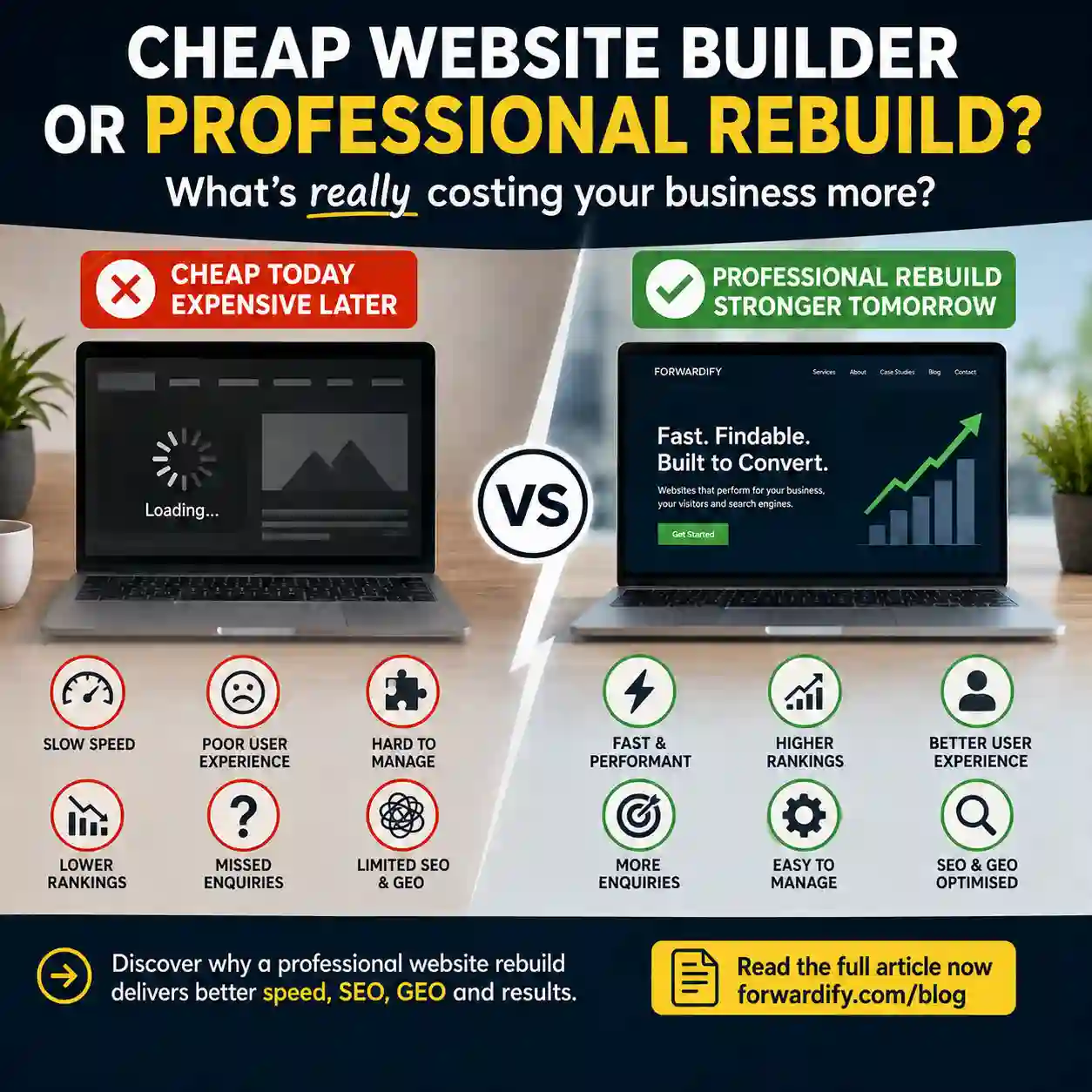
A cheap website builder can be a useful starting point, but it is not always the best long-term foundation for a business that depends on enquiries. If your WordPress, Wix, IONOS or template-based website is slow, difficult to manage, hard to rank, awkward to update or failing to convert visitors, the real cost may be higher than the monthly fee suggests.
The real cost of a cheap website is not always the price you pay upfront
Many UK businesses start with a low-cost website because it feels practical. A basic website builder can help you get online quickly, add a few pages and show that your business exists. For a very small business, side project or early-stage idea, that can be enough.
The problem starts when the website becomes more important to the business. Once you need better rankings, faster pages, more enquiries, clearer content, reliable tracking, stronger trust signals and a structure that supports SEO and GEO, the limitations of a cheap or difficult-to-manage website become more obvious.
The question is not simply “how much does a website cost?” The better question is: “what is this website costing us in lost enquiries, wasted time, weak search visibility and poor user experience?”
Cheap website builder vs professional website rebuild
Website builders such as Wix, IONOS and similar platforms can be useful for simple brochure sites. WordPress can also be excellent when it is planned, developed and maintained properly. The issue is rarely the platform name alone. The issue is whether the website has been built around performance, search intent, technical quality and conversion goals.
A professional rebuild looks beyond the surface design. It considers page speed, Core Web Vitals, content structure, URL mapping, redirects, metadata, internal links, schema, mobile usability, forms, trust signals and the steps a visitor needs to take before becoming an enquiry.
| Area | Cheap builder or unmanaged template site | Professional rebuild |
|---|---|---|
| Design | Often based on a generic template that may look similar to many other sites. | Designed around your services, audience, trust signals and enquiry journey. |
| Page speed | Can become heavy due to themes, apps, plugins, scripts or visual builders. | Built with performance, image delivery, CSS, JavaScript and Core Web Vitals in mind. |
| SEO | Often has weak headings, thin service pages, poor internal links and limited technical control. | Planned around crawlability, keyword intent, metadata, redirects and page structure. |
| GEO and AI search | Content may be vague, duplicated, unstructured or difficult for AI systems to interpret. | Uses clearer answers, FAQs, entity signals, schema and structured service content. |
| Management | Edits can become awkward, risky or dependent on plugins and platform limitations. | Built with a clearer structure, cleaner templates and a practical update process. |
| Conversions | Forms, calls to action and page journeys may be added as an afterthought. | Conversion paths are planned into the design, copy, forms and layout from the start. |
When a website builder is good enough
A website builder is not automatically a bad choice. For some businesses, it may be a sensible short-term option. A simple DIY website can work when you only need a small online presence, have no serious SEO ambitions and are not yet relying on the website to produce regular leads.
A builder or low-cost template may be suitable if:
- You only need a basic holding page or small brochure website.
- You are testing a new business idea before investing more heavily.
- You do not need custom functionality, integrations or advanced forms.
- You are not competing in a difficult SEO market.
- You have the time and confidence to manage content, images, layout and technical settings yourself.
However, once the website becomes part of your sales process, marketing strategy or local search presence, a cheap website can start to become a bottleneck.
Signs your cheap website is now holding you back
Most businesses do not need a rebuild because their site is old. They need a rebuild because the website no longer supports how the business needs to win enquiries. The design may be dated, but the bigger issues are often hidden in speed, structure, content and user experience.
You may need a professional rebuild if your website is:
- Slow to load on mobile or fails Core Web Vitals checks.
- Difficult to update without breaking layouts.
- Built from bloated themes, plugins or apps that are hard to control.
- Missing clear service pages for your most important offers.
- Not ranking for local or commercial search terms.
- Generating traffic but very few enquiries.
- Using vague copy that does not explain what you do clearly.
- Missing trust signals, proof, reviews, case studies or clear calls to action.
- Not structured for SEO, GEO, LLM optimisation or AI search visibility.
- Hard to measure because forms, calls and conversion events are not tracked properly.
Forwardify’s website rebuild services are designed for exactly this stage: when your existing site has some value, but the design, structure, speed or search foundations need serious improvement.
Core Web Vitals: why speed matters beyond a Lighthouse score
Page speed is not just a technical vanity metric. Slow websites lose attention, reduce trust and create friction before a visitor has even read your offer. A website that takes too long to load, jumps around while loading or feels sluggish on mobile can make a business look less professional than it really is.
Core Web Vitals focus on three important parts of user experience:
- Loading performance: how quickly the main content appears.
- Responsiveness: how quickly the page responds when someone interacts with it.
- Visual stability: whether the layout moves unexpectedly while loading.
Cheap websites and template-heavy sites can struggle here because they often rely on large images, unused scripts, visual builder code, multiple plugins, tracking scripts, third-party widgets and generic themes. You may be able to improve some of this, but there is a point where optimisation becomes a patch rather than a proper fix.
A professional rebuild allows performance to be planned into the structure of the site. Image sizes, layout behaviour, scripts, CSS, fonts, templates, hosting considerations and mobile experience can all be reviewed properly. Forwardify’s page speed optimisation service focuses on these practical performance improvements, including Core Web Vitals, image delivery, scripts, caching and technical performance.
SEO: a rebuild should protect rankings, not wipe them out
One of the biggest risks with a website redesign is treating it as a visual project only. A new design can look better and still damage search visibility if URL changes, redirects, page titles, headings, internal links and content are handled badly.
That is why an SEO-friendly website redesign should include:
- A crawl of the current website before changes are made.
- A list of existing URLs, rankings and valuable pages.
- A plan for which content should be kept, improved, merged or removed.
- Redirect mapping for any URL changes.
- Improved metadata, headings and service page structure.
- Internal links between related services and supporting articles.
- Local SEO signals for the areas you serve.
- Post-launch checks to catch crawl, redirect or indexing issues quickly.
This is where a professional rebuild differs from simply “making the site look modern”. Good SEO structure helps search engines understand what each page is about and helps visitors find the right information faster. Forwardify’s SEO services cover technical SEO, content structure, metadata, internal linking, local SEO and content gap planning.
GEO and AI search: why old websites need clearer structure
Search is changing. People still use Google, but they also use AI tools, answer engines and AI-enhanced search results to compare services, shortlist providers and ask more detailed questions. A website now needs to be clear enough for humans, search engines and AI systems to understand.
Generative Engine Optimisation, or GEO, builds on SEO. It makes your website easier for AI systems to interpret by improving service definitions, entity clarity, FAQs, answer-ready content, internal links and schema. A cheap website may have pages that look acceptable to a person, but still lack the structure and clarity needed for modern search experiences.
A rebuild is a useful opportunity to improve:
- Clear explanations of who you are, what you do and where you work.
- Structured service pages with direct answers to common buyer questions.
- FAQ sections that support both users and answer engines.
- Schema recommendations for services, FAQs, organisation details and local relevance.
- Consistent terminology across pages so your expertise is easier to understand.
- Internal links that connect services, supporting guides and conversion pages.
Forwardify’s Generative Engine Optimisation services and LLM optimisation services are designed to help websites become clearer, more structured and more useful for AI-led discovery.
Why “easy to build” can become difficult to manage
Website builders often promote ease of use, and at the start that may be true. You can choose a template, drag sections into place and publish quickly. But as the site grows, management can become more difficult.
Common problems include:
- Design changes that need to be repeated manually across many pages.
- Mobile layouts that look different from the desktop editor.
- Plugins, widgets or apps adding code that slows pages down.
- SEO settings being missed because they are hidden across different screens.
- Blog posts and service pages becoming inconsistent over time.
- Forms or tracking tools being difficult to customise properly.
- Content being added without a clear internal linking or keyword strategy.
A professional rebuild should make the website easier to manage, not more complicated. The goal is to create a stronger foundation: clearer templates, better content hierarchy, cleaner page structure and a more practical process for future updates.
The hidden business cost of a slow or confusing website
For many businesses, the biggest cost is not the website build itself. It is the value of missed opportunities. A slow, unclear or outdated website can affect trust before a conversation starts. Visitors may leave before the page loads, fail to understand the offer, abandon a long form, choose a competitor or never return.
That cost is difficult to see because it usually appears as silence: fewer enquiries, weaker leads, lower conversion rates and wasted marketing spend. You may be paying for SEO, social media, ads, directories or referrals, but sending people to a website that does not make the most of that traffic.
This is why conversion thinking should be included in the rebuild process. Your website should make the next step obvious, whether that is requesting a quote, booking a call, sending a message, downloading information or comparing services. Forwardify’s conversion rate optimisation services focus on page journeys, forms, calls to action, trust signals, mobile usability and analytics.
What affects website redesign cost in the UK?
Website redesign cost in the UK varies because not every rebuild has the same scope. A small brochure site with a few pages is very different from a service-led website that needs SEO migration, copywriting, custom forms, speed optimisation and GEO-ready content.
The main factors that affect website redesign cost include:
- Page count: the number of core pages, service pages, blog templates and landing pages required.
- Content work: whether existing copy can be reused or needs rewriting for clarity, SEO and conversion.
- SEO migration: whether URLs, redirects, metadata, rankings and internal links need to be protected.
- Performance work: whether Core Web Vitals and page speed need significant improvement.
- Design complexity: whether the site needs a simple refresh or a full custom design system.
- Functionality: forms, integrations, calculators, booking features, portals or bespoke development.
- GEO and LLM readiness: structured content, FAQs, schema and answer-ready sections.
- Post-launch support: testing, monitoring, analytics, technical support and ongoing improvements.
A cheap rebuild that ignores these areas can become expensive later. A professional rebuild costs more because it solves more than the appearance of the website. It improves the commercial, technical and search foundations behind it.
A practical website rebuild checklist
If you are deciding whether to rebuild your existing website, use this checklist to assess whether the project is being planned properly.
- Audit the current website before making design decisions.
- Review traffic, rankings, enquiry data and key landing pages.
- Identify which pages should be kept, improved, merged or removed.
- Map all existing URLs and plan redirects before launch.
- Rewrite weak service pages around real search intent and buyer questions.
- Improve titles, meta descriptions, headings and internal links.
- Check mobile usability, calls to action, forms and trust signals.
- Review Core Web Vitals, image weight, scripts, CSS and layout stability.
- Add FAQ sections and answer-ready content where useful.
- Consider schema recommendations for services, FAQs and local business details.
- Set up analytics and conversion tracking for forms, calls and key actions.
- Test redirects, forms, page speed and indexing signals after launch.
Forwardify combines website development, SEO, page speed optimisation, content creation and GEO thinking so a rebuild becomes a stronger long-term platform rather than a cosmetic refresh.
When to optimise your current site instead of rebuilding
Not every website needs to be rebuilt immediately. Sometimes the existing platform is good enough and the best first step is a focused audit, speed improvement, SEO update or content refresh.
Optimisation may be the better starting point if:
- The design is still suitable and the site is easy to manage.
- The site already ranks well and only needs careful improvement.
- The main issues are image size, metadata, internal links or content depth.
- The platform gives enough control to fix technical issues properly.
- You need a staged improvement plan rather than a full rebuild now.
A good agency should not recommend a rebuild simply because it is the largest project. The right recommendation depends on your current website, your commercial goals and the gap between where the site is now and where it needs to be.
When a professional rebuild is the better investment
A professional rebuild makes sense when the existing website has reached the limit of what sensible optimisation can fix. This often happens when the design is outdated, the structure is messy, the content is thin, the platform is frustrating, the site is slow and the business needs better visibility or enquiries.
It is especially worth considering if your business depends on local SEO, service-led enquiries, trust, expertise and clear differentiation. A better website can help you explain your offer more clearly, rank for more relevant terms, support AI-search visibility and turn more visitors into conversations.
For businesses in Watford, Rickmansworth, Hertfordshire, London and across the UK, Forwardify provides professional website rebuilds that combine design, development, SEO, GEO, content, performance and conversion thinking from the start.
FAQs: cheap website builders vs professional rebuilds
Not automatically. WordPress, Wix and IONOS websites can work for simple sites, but SEO performance depends on structure, content quality, speed, metadata, internal links, mobile usability and technical control. A poorly planned site on any platform can struggle to rank.
A rebuild usually makes sense when the website is slow, outdated, difficult to update, poorly structured, weak for SEO, hard to customise or failing to generate enquiries. If the foundations are still strong, a focused SEO, speed or content improvement project may be enough.
Yes. A rebuild can improve Core Web Vitals by reducing bloated templates, optimising images, improving CSS and JavaScript, reducing layout shift, improving loading behaviour and creating a cleaner mobile experience.
A poorly managed rebuild can damage rankings, but an SEO-led rebuild reduces that risk by mapping URLs, planning redirects, preserving valuable content, improving metadata, maintaining internal links and checking the site carefully after launch.
GEO helps make rebuilt pages clearer for AI answer engines and large language models. It can include stronger service definitions, concise answer blocks, FAQs, schema recommendations, entity clarity and better internal linking between related topics.
The biggest mistake is judging the website only by the upfront cost or how it looks. A website also needs to load quickly, explain services clearly, rank for relevant searches, convert visitors and remain manageable as the business grows.
Ready to replace a slow, awkward or underperforming website?
Forwardify rebuilds websites around speed, SEO, GEO, content clarity and better enquiry journeys. If your current site is cheap to own but expensive in lost opportunities, we can help you plan the right next step.

Thomas Carpenter
FounderWorking closely with clients to create visually compelling, strategic solutions built for long-term growth is what we do.
Contact us Whatsapp