AI Visibility Audit Checklist
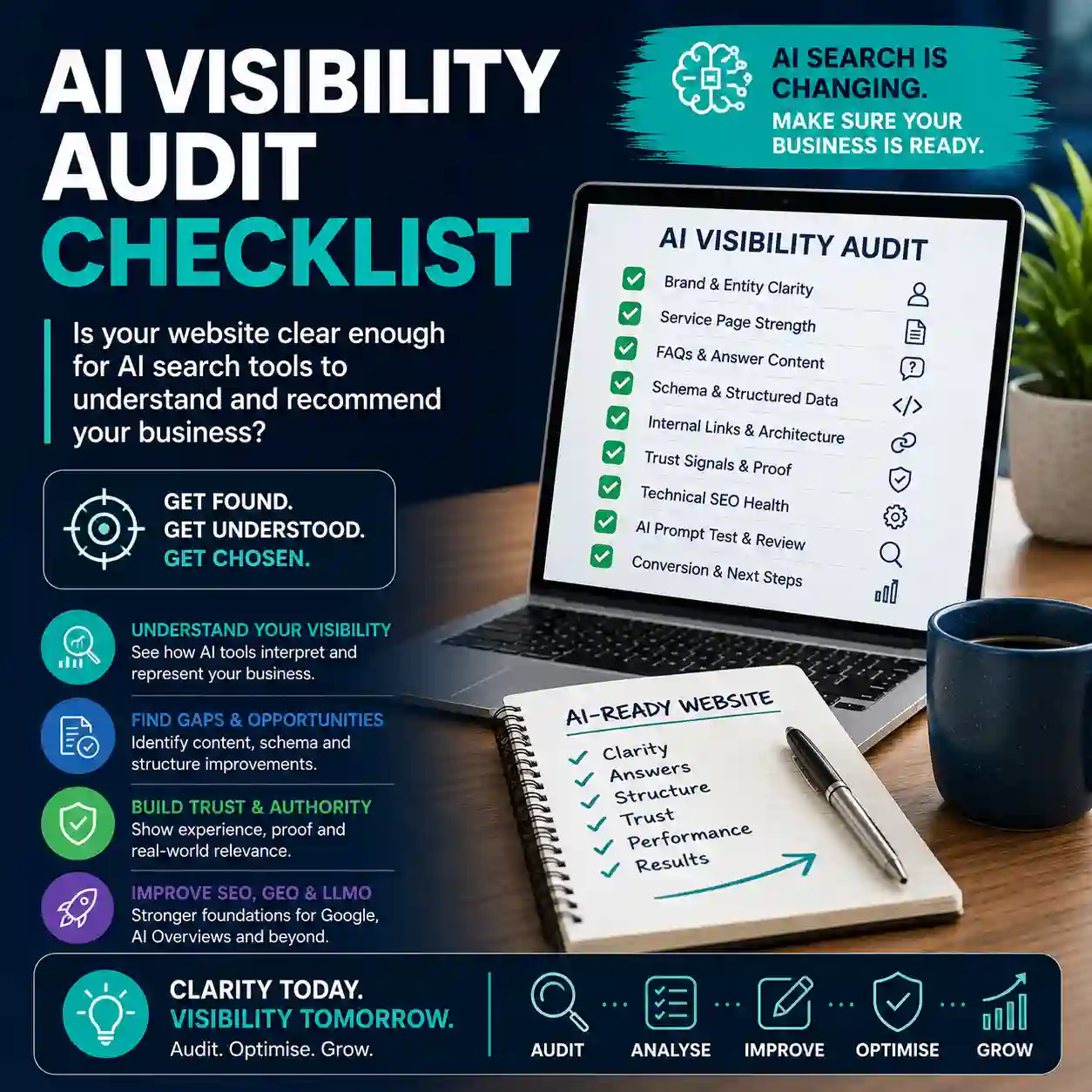
An AI visibility audit helps you understand whether your website is clear enough for AI search tools, answer engines and large language models to interpret. For UK businesses, this is becoming an important part of SEO, GEO and content strategy because customers are no longer only searching through traditional search results.
What is an AI visibility audit?
An AI visibility audit is a structured review of how clearly your website communicates your business, services, expertise, location, trust signals and answers. The aim is to make your content easier for people, search engines and AI systems to understand.
It does not replace SEO. A useful audit should build on strong SEO foundations including crawlability, page structure, metadata, internal links, content quality, speed and user experience. The difference is that AI visibility also looks closely at entity clarity, answer-ready content, schema, service definitions and whether your website gives enough evidence for AI systems to summarise your business accurately.
- Can AI systems understand who you are?
- Can they identify what services you offer?
- Can they connect your services to the locations and audiences you serve?
- Can they find concise answers to common customer questions?
- Can they see evidence of trust, expertise and real-world relevance?
Why AI visibility matters for SEO and GEO
Search behaviour is changing. People still use Google, but they also ask AI tools to compare providers, explain services, summarise options and recommend next steps. If your website is vague, thin, outdated or poorly structured, AI systems have less reliable information to work with.
Good AI visibility is not about tricking tools into mentioning you. It is about making your website more useful, easier to interpret and better supported by clear evidence. That usually improves the human experience too.
- Clearer service pages help potential customers understand what you do.
- Better FAQs answer real questions before someone contacts you.
- Schema can reinforce important page and business signals.
- Internal links help connect services, locations, case studies and guides.
- Trust signals make your website more credible to users and easier to assess.
Forwardify’s GEO services and LLM optimisation services are designed around this type of clearer, structured and answer-ready website improvement.
AI visibility audit checklist
Use this checklist to review whether your website is ready for AI-led search discovery. You do not need to complete every item in one day, but each area helps make your business easier to understand and more useful to potential customers.
- Brand clarity: your website clearly states who you are, what you do and who you help.
- Service definitions: each main service has its own clear explanation, not just a short list of keywords.
- Location relevance: your target areas are mentioned naturally where they help users understand your coverage.
- Answer-ready content: common customer questions are answered directly and concisely.
- FAQ structure: useful FAQs appear on service pages and supporting guides where relevant.
- Schema markup: structured data is reviewed for organisation, services, FAQs, articles and local relevance where appropriate.
- Internal links: service pages, blogs, case studies and contact pages are connected logically.
- Evidence and trust: your site includes experience, examples, reviews, case studies, process details and clear contact information.
- Technical SEO: important pages can be crawled, indexed, loaded quickly and understood correctly.
- Conversion clarity: visitors know what to do next after reading a page.
1. Check whether your homepage explains the business clearly
Your homepage is often the strongest entity page on your website. It should make the business easy to understand within seconds. If a visitor, search engine or AI system has to guess what you do, your visibility is weaker than it should be.
Review whether your homepage explains:
- Your business name and core offer.
- Your main services.
- Your target audience.
- Your geographic coverage.
- Your experience, proof and differentiators.
- Your next-step call to action.
For many businesses, a homepage that has grown over time can become vague. An AI visibility audit should identify whether the homepage is still a strong summary of the business or whether it needs clearer positioning.
2. Review service pages for entity and intent clarity
AI systems need clear service information. A short page with a heading and a few generic paragraphs may not be enough to explain what the service includes, who it is for, where it applies and why someone should choose you.
Each important service page should ideally include:
- A clear H1 focused on the service.
- A concise explanation of what the service is.
- Who the service is suitable for.
- Problems the service solves.
- What is included.
- Relevant FAQs.
- Proof, process or examples.
- Clear internal links to related services.
- A strong call to action.
If one page tries to cover too many different services, both users and AI tools may struggle to understand which service is most relevant. Forwardify can support this through SEO services, content planning and clearer service page architecture.
3. Add concise answers to real customer questions
AI answer engines often work best with content that answers real questions clearly. That does not mean every page should become a basic FAQ page, but your website should include helpful answer blocks where users naturally need reassurance or explanation.
Useful question types include:
- What does this service include?
- How much does it usually cost?
- How long does it take?
- Who is it suitable for?
- What is the difference between this and another service?
- What happens during the process?
- What should a customer prepare before getting started?
Forwardify’s content creation services can help create clear service pages, blog articles, FAQs and answer-ready sections shaped around both SEO and GEO.
4. Check schema, metadata and structured signals
Schema does not guarantee AI mentions or higher rankings, but it can help reinforce important information about pages, services, FAQs, articles and organisations. During an AI visibility audit, schema should be reviewed alongside the visible page content.
Check whether your website uses suitable structured data for:
- Organisation or local business details.
- Service pages.
- FAQ sections.
- Blog articles and guides.
- Breadcrumbs.
- Reviews or testimonials where appropriate and valid.
The content on the page still matters most. Schema should support the page, not say something the visible content does not back up.
5. Strengthen trust and evidence
AI visibility is closely linked to clarity and confidence. If your website makes claims but provides little evidence, it becomes harder for users and systems to assess your business properly.
Trust signals can include:
- Case studies or project examples.
- Client reviews or testimonials.
- Years of experience.
- Clear process steps.
- Team or author information.
- Professional accreditations where relevant.
- Location and contact details.
- Specific examples of results or completed work.
Do not add generic trust badges or exaggerated claims. The aim is to show useful evidence that helps a real customer feel confident enough to enquire.
6. Audit internal links and topic clusters
Internal links help visitors move between related pages, but they also help search engines and AI systems understand how your services and content connect. A good AI visibility audit should check whether important pages are isolated or properly supported.
Review whether your internal links connect:
- Homepage to core services.
- Service pages to related services.
- Blog articles to commercial pages.
- Case studies to relevant service pages.
- FAQs and guides to contact or enquiry paths.
- Location references to useful service or landing pages.
Internal links should feel natural. Avoid forcing exact-match keyword links everywhere. The best links help users continue their journey and help systems understand the relationship between pages.
7. Test AI prompts carefully
You can use AI tools to test how clearly your business is represented, but the results should be treated as indicators rather than guarantees. AI systems can vary by tool, date, prompt and available data.
Useful prompt tests include:
- “What does [business name] do?”
- “Is [business name] suitable for [service]?”
- “Who provides [service] in [location]?”
- “Compare [business name] with other providers.”
- “Summarise the services offered by [business name].”
If the answers are vague, wrong or incomplete, that may indicate your website needs clearer service definitions, stronger entity signals, better FAQs, more supporting content or improved external consistency.
8. Combine AI visibility with conversion improvements
Being visible is only useful if visitors know what to do next. A website can become clearer to AI systems and still fail commercially if pages are confusing, forms are awkward or calls to action are weak.
Review whether your key pages include:
- A clear next step above the fold.
- Simple contact or enquiry options.
- Trust signals near conversion points.
- Strong benefit-led calls to action.
- Mobile-friendly forms.
- Fast loading templates.
- Analytics and event tracking for important actions.
If your website already gets traffic but enquiries are low, combine AI visibility work with conversion rate optimisation so clearer content also supports better results.
When should you run an AI visibility audit?
An AI visibility audit is useful when your website is important for enquiries, local visibility, lead generation or brand trust. It is especially valuable before a website rebuild, after launching new service pages, or when competitors are starting to appear more clearly in AI search results.
You should consider an audit if:
- Your website explains services in a vague or outdated way.
- Your business has grown but the website structure has not kept up.
- You have strong experience but limited proof or case studies online.
- You rely on Google and local search for enquiries.
- You want your content to be clearer for AI answer engines.
- Your service pages do not include FAQs or structured answer sections.
- You are planning a redesign or website rebuild.
AI visibility audit priorities for small businesses
Small businesses do not need to overcomplicate AI visibility. The most useful improvements are often practical, commercial and easy to understand.
- Make every main service page clearer and more complete.
- Add helpful FAQs based on real customer questions.
- Improve internal links between services, guides and contact pages.
- Review schema and metadata for important pages.
- Add stronger trust signals, examples and process information.
- Improve page speed and mobile usability.
- Create supporting articles for questions that do not need full service pages.
The goal is not to chase every AI trend. The goal is to build a website that is easier to understand, easier to trust and easier to choose.
FAQs: AI Visibility Audit
An AI visibility audit reviews whether your website clearly explains your brand, services, locations, expertise, FAQs, schema, internal links and trust signals so AI search tools and large language models can interpret your business more accurately.
No. AI visibility overlaps with SEO, but it focuses more on clarity, entity signals, answer-ready content, structured information and whether AI systems can understand and summarise your business confidently.
No responsible provider can guarantee AI mentions. An audit helps improve the clarity, usefulness and structure of your website so your business is easier for AI systems to understand, verify and summarise.
Start with your homepage, main service pages, about page, contact page, key blog guides and any location pages. These pages usually contain the strongest signals about who you are, what you offer and why customers should trust you.
Schema can help reinforce important page, business, service, FAQ and article signals, but it should support accurate visible content. Schema is not a substitute for clear, useful and trustworthy page copy.
Yes. A rebuild is an ideal time to improve content structure, service clarity, internal links, schema, FAQs, performance and conversion journeys before the new website goes live.
Need an AI visibility audit for your website?
Forwardify can review your website for SEO, GEO and LLM readiness, then recommend practical improvements to make your business clearer to users, Google and AI search systems.

Thomas Carpenter
FounderWorking closely with clients to create visually compelling, strategic solutions built for long-term growth is what we do.
Contact us Whatsapp