Website Design Brief Template for UK Businesses
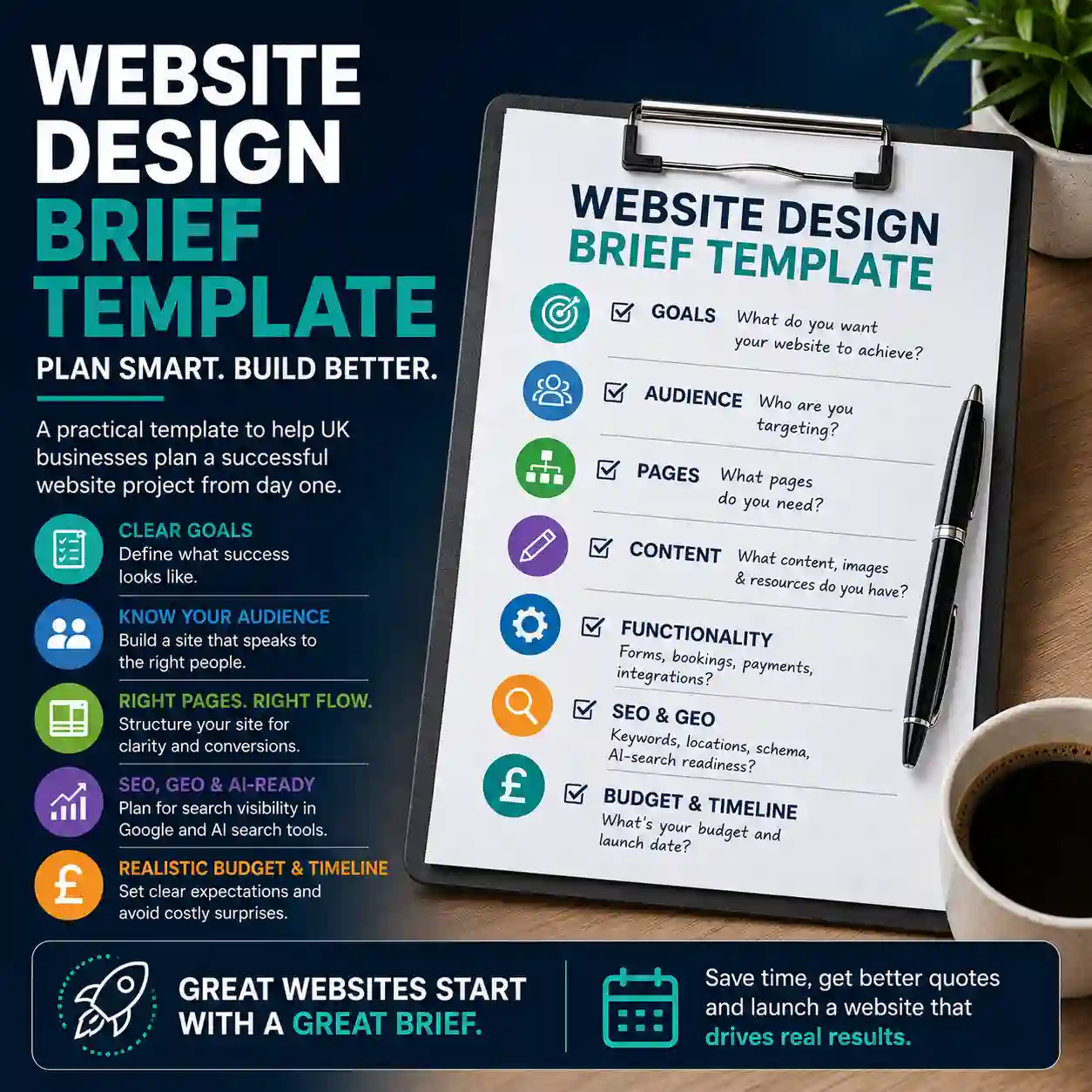
A website design brief helps turn a rough idea into a clear, buildable plan. Whether you need a brand-new website, a redesign or a full rebuild, the brief gives your web designer the context needed to quote accurately, plan properly and create a website that supports real business goals.
What is a website design brief?
A website design brief is a planning document that explains what your business needs from a new website. It covers your goals, audience, pages, features, content, brand preferences, SEO requirements, budget, timeline and approval process.
It does not need to be complicated. The best website briefs are clear, practical and honest. They help your designer understand what you want to achieve, what already exists, what problems need solving and what a successful project should deliver.
- It helps avoid vague quotes and unclear expectations.
- It gives the designer enough information to recommend the right approach.
- It reduces delays caused by missing content, unclear features or changing priorities.
- It keeps the project focused on business outcomes, not just visual preferences.
Why a clear brief leads to a better website
A website should do more than look professional. It should explain your services clearly, support search visibility, guide visitors towards enquiries and work properly across devices. Without a clear brief, it is easy for a project to become design-led without enough focus on content, SEO, conversion or long-term maintenance.
A strong brief helps your website designer understand:
- What your business does and who you serve.
- What problems your current website has.
- What pages and services matter most.
- What actions visitors should take.
- What content, images and proof already exist.
- What technical features or integrations are required.
- How SEO, GEO and AI-search readiness should be considered from the start.
Forwardify’s website design services are built around clear user journeys, responsive layouts, SEO-ready structure and conversion-focused planning. A good brief gives that process a stronger starting point.
Website design brief template: quick version
Use this quick website design brief template before requesting a quote or starting a project. You can copy these headings into a document and answer each section in plain English.
- Business overview: who you are, what you do and where you operate.
- Project type: new website, redesign, rebuild, landing page, ecommerce, booking system or custom development.
- Main goals: more enquiries, better SEO, clearer services, faster website, stronger brand, easier updates or improved conversions.
- Target audience: who the website needs to attract, reassure and convert.
- Pages required: homepage, service pages, about, contact, blog, case studies, FAQs, location pages or specialist landing pages.
- Content requirements: existing copy, new copywriting, photography, video, case studies, downloads, testimonials and FAQs.
- Design direction: brand colours, visual preferences, competitor examples and websites you like or dislike.
- Functionality: forms, payments, bookings, logins, calculators, integrations, downloads, maps or custom workflows.
- SEO and GEO needs: keywords, locations, redirects, metadata, schema, content structure and AI-search-ready answers.
- Budget and timeline: realistic budget range, launch date, key milestones and approval process.
1. Business background
Start by explaining the business in a way someone outside your industry can understand. This is useful for the designer, developer, copywriter and SEO planner because it defines the commercial context of the project.
Include:
- Your business name and trading name.
- Your main services or products.
- Your location and service areas.
- Your ideal customers.
- Your key differentiators.
- Your current website URL, if you have one.
- Any important competitors or comparison websites.
For example, a local service business may need a website that prioritises calls and quote requests, while a professional services firm may need stronger trust signals, case studies and explanatory content.
2. Project goals
Website projects are easier to scope when the goals are clear. “We need a modern website” is a starting point, but it does not explain what the website needs to achieve.
Useful goals include:
- Increase enquiry form submissions.
- Improve local SEO visibility.
- Make services easier to understand.
- Rebuild an old, slow or hard-to-update website.
- Improve mobile experience.
- Strengthen trust with case studies, reviews or proof.
- Prepare content for AI search, GEO and LLM interpretation.
- Improve conversion rates from existing traffic.
- Support a rebrand or new business direction.
Try to prioritise the top three goals. If everything is equally important, the project can lose focus.
3. Target audience and user journeys
Your website should be designed around the people who need to use it. A good brief explains who those people are, what they care about and what questions they need answered before they enquire.
Include details such as:
- Customer types, sectors or locations.
- Typical customer problems.
- What makes them trust a provider.
- Common objections or concerns.
- What they need to know before contacting you.
- Preferred enquiry actions, such as calls, forms, WhatsApp or bookings.
This helps shape page structure, calls to action, content depth and the order in which information appears on each page.
4. Pages and sitemap
A website brief should include a first draft of the pages you think you need. This does not have to be final. Your designer or SEO specialist may recommend combining, splitting or renaming pages based on search intent and user journeys.
Common pages include:
- Homepage
- About page
- Main service pages
- Location pages
- Case studies or portfolio
- Blog or insights
- FAQs
- Contact page
- Privacy policy and terms pages
For SEO-focused websites, avoid putting every service on one generic page if each service has different search intent. A clear sitemap can support better visibility, easier navigation and stronger conversion journeys.
5. Content and messaging
Content is often the biggest cause of website project delays. Your brief should explain what content already exists, what needs rewriting and what still needs to be created.
Include:
- Existing website copy that should be kept or improved.
- New service descriptions required.
- Testimonials, reviews or case studies.
- Team profiles or author information.
- Photos, videos, logos and brand assets.
- Downloads, brochures or technical documents.
- FAQs based on real customer questions.
If you do not have copy ready, say so early. Forwardify’s content creation services can help plan and write website copy, service pages, FAQs and AI-search-ready answer sections.
6. Design preferences and brand direction
Design preferences are useful, but they should support the website’s goals rather than replace them. A good brief explains the type of impression the website needs to create and includes examples that help your designer understand the direction.
Include:
- Existing brand guidelines, logo files and colour references.
- Websites you like and why you like them.
- Websites you dislike and why they are not right.
- Preferred tone, such as premium, friendly, technical, bold or minimal.
- Any accessibility or readability requirements.
- Photography style, illustration style or icon preferences.
Try to avoid asking for a design to copy another website. Use examples to communicate taste, structure and expectations, then let your designer create something appropriate for your own business.
7. Functionality and integrations
Functionality can significantly affect cost, timeline and development complexity. Your brief should list every feature you know you need, even if you are not sure how it should be built.
Examples include:
- Contact forms and quote request forms.
- Booking or appointment systems.
- Payment or ecommerce features.
- Customer portals or login areas.
- CRM, email marketing or API integrations.
- Download areas or gated content.
- Calculators, filters or search functionality.
- Map, review or third-party embeds.
- Analytics, conversion tracking and event tracking.
Forwardify’s website development services can support custom website builds, responsive front-end development, MVC and .NET support, CMS work, forms, integrations, performance and security improvements.
8. SEO, GEO and AI-search requirements
SEO should not be added after the design is finished. If search visibility matters, the brief should explain which services, locations, keywords and questions the website needs to support.
Include:
- Important services you want to be found for.
- Locations you want to target.
- Existing pages that currently rank or generate enquiries.
- Competitors that appear in search results.
- FAQs that customers ask before buying.
- Pages that need metadata, schema and internal links.
- AI-search goals, such as clearer entity signals and answer-ready content.
For modern websites, it is worth considering both search engine optimisation and generative engine optimisation during the planning stage. Clear headings, structured content, FAQs, schema and useful internal links can help both users and search systems understand the website.
9. Existing website, rebuild and migration details
If you already have a website, the brief should explain what needs to happen to it. A redesign or rebuild can improve performance and clarity, but it should also protect useful pages, traffic and search value.
Include:
- Your current website URL.
- Pages that should be kept.
- Pages that are outdated or no longer needed.
- Known technical problems.
- CMS or hosting issues.
- Existing analytics or Search Console access.
- Important URLs that may need redirects.
- Content that should be migrated, rewritten or merged.
If your current website is slow, unclear, hard to manage or underperforming, Forwardify’s website rebuild services can include audit, URL mapping, SEO migration support, GEO-ready structure and launch checks.
10. Budget, timeline and approvals
A realistic budget and timeline helps your designer recommend the right solution. It also prevents time being spent on options that are too large, too limited or not aligned with the commercial value of the project.
Your brief should include:
- Ideal launch date.
- Reason for the deadline.
- Approximate budget range.
- Decision-makers involved.
- Who will provide content and feedback.
- Internal approval process.
- Any fixed events, campaigns or seasonal deadlines.
If you are unsure about budget, explain what outcome you want. A good agency can help shape a phased approach, starting with the work that matters most.
Website design brief example questions
Use these questions to create a stronger brief before speaking to a website designer:
- What is the main reason for the new website?
- What does the current website fail to do?
- Which services are most profitable or strategically important?
- Who are the most valuable customers?
- What should visitors do after landing on the website?
- Which pages are essential for launch?
- What content already exists?
- What content needs writing from scratch?
- Are there any features that affect cost or development time?
- How important are SEO, GEO and AI-search visibility?
- What does success look like three months after launch?
What to send with your website design brief
Alongside the written brief, it helps to send useful supporting materials. This gives your designer a better understanding of your business and reduces back-and-forth at the start of the project.
- Logo files and brand guidelines.
- Current website access or CMS information where appropriate.
- Analytics or search performance exports if available.
- Photography, videos and image libraries.
- Brochures, sales documents or service sheets.
- Example websites and competitor websites.
- Customer FAQs and sales objections.
- Testimonials, reviews and case studies.
The more useful context you provide, the easier it is to create a website that feels accurate, credible and commercially focused.
Common website brief mistakes to avoid
A weak brief can lead to poor scoping, missed requirements and a website that does not fully support the business. Avoid these common mistakes:
- Only focusing on design: appearance matters, but content, structure, SEO and conversion matter too.
- Leaving content until the end: missing copy and images can delay launch and weaken the final website.
- Not mentioning SEO: existing rankings, URLs and search opportunities should be considered early.
- Hiding budget expectations: a budget range helps your designer recommend the right scope.
- Forgetting integrations: forms, payments, bookings and CRM connections can affect development planning.
- Trying to target every audience: a focused website usually converts better than a generic one.
- Not defining success: clear goals make it easier to judge whether the project has worked.
Website design brief template summary
A good website brief does not need to be perfect. It needs to be useful. Start with your business goals, explain your audience, list the pages and features you need, gather your content, define SEO requirements and be honest about budget and timeline.
The clearer the brief, the easier it is for your web designer to recommend the right structure, content, technology and launch plan.
- Use the brief to define the outcome, not just the look.
- Include SEO, GEO and content planning from the start.
- List functionality early so development can be scoped properly.
- Prepare content and approvals before the project begins.
- Choose a web design partner who understands design, development, SEO and conversion together.
FAQs: Website Design Brief Template
A website design brief should include your business background, project goals, target audience, required pages, content needs, design preferences, functionality, SEO requirements, budget, timeline and approval process.
You do not need a perfect brief, but a clear outline helps the designer quote more accurately. It reduces assumptions about page count, content, features, SEO and timescale.
Most small business website briefs can be two to five pages long. The quality of the information matters more than the length. Clear goals, pages, content, functionality and budget are more useful than a long but vague document.
Yes. SEO should be considered before design and development begin. Your brief should mention important services, locations, current rankings, existing URLs, competitor websites, keyword themes and any pages that need to be protected or improved.
A website brief explains the business goals, audience, content, pages and desired outcomes. A specification is usually more detailed and may define technical requirements, functionality, integrations, acceptance criteria and development rules.
Yes. Forwardify can help turn your goals, current website problems, service priorities and SEO requirements into a practical website plan before design and development begin.
Need help turning your website idea into a clear plan?
Forwardify can help you define the right website structure, content, SEO foundations, development scope and launch plan before your project begins.

Thomas Carpenter
FounderWorking closely with clients to create visually compelling, strategic solutions built for long-term growth is what we do.
Contact us Whatsapp